
GP lawyers at the Supreme Court on Bill 21
This week, the Supreme Court of Canada heard appeals regarding Quebec’s Bill 21, which prohibits certain public servants from wearing religious symbols or from performing their functions with their face covered. This case offers the Supreme Court of Canada the first opportunity since 1988 to consider the scope and effect of section 33 of the Charter, the notwithstanding clause. Goldblatt Partners LLP lawyers represented multiple interveners in the case.
Steven Barrett and Melanie Anderson appeared on behalf of the Canadian Labour Congress. Their intervention focused on the dialogue principle between the legislatures and the courts which must inform the interpretation of Charter rights. They submitted that the notwithstanding clause cannot be invoked “pre-emptively” by the legislature before the court has issued a final judicial determination of compliance with the Charter. Alternatively, they submitted that the court retains jurisdiction to issue declarations about compliance with the Charter even after the notwithstanding clause has been invoked.
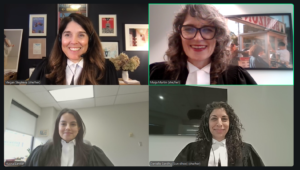 Danielle Sandhu and Husna Sarwar, together with co-counsel Megan Stephens and Maija Martin, appeared on behalf of the Barbra Schlifer Commemorative Clinic and Women in Canadian Criminal Defence. Their intervention encouraged the Court to adopt a purposive interpretation of section 28 of the Charter as a substantive guarantee of gender equality. They submitted that the notwithstanding clause does not override section 28 of the Charter and that Bill 21 operates to prohibit hijab, niqab, and burka-wearing Muslim women from practicing criminal law or performing government-funded legal work, which restricts the rights of potential clients who may wish to choose these lawyers as their representatives.
The webcast from the hearing can be viewed here.
Lawyers
Steven Barrett, Melanie Anderson, Husna Sarwar, Danielle Sandhu